Leaving the plain
Kraków sits comfortably on the flat basin of the upper Vistula, a city of courtyards and church towers that gives very little warning of the mountains to come. When you pull out of its southern suburbs, the land is still gentle, patched with allotments, warehouses and the occasional roadside stall selling apples out of crates. There is no drama yet. The road signs simply say Zakopane, and the number grows smaller with every kilometre, and that is the only clue that something is changing underfoot.
This road has a name that every Pole recognises: the Zakopianka. It has carried skiers, pilgrims, honeymooners and homesick highlanders for generations, and it has earned, fairly or not, a reputation as one of the more congested routes in the country. On a July Friday or a snowy Saturday in January, it can crawl. On a quiet Tuesday morning in the shoulder season it can feel almost empty, just fields, a few slow tractors, and the sense of a landscape gathering itself before it lifts.
The first towns south of Kraków, places like Myślenice, belong to the Beskid foothills rather than the Tatras themselves. Here the road starts to bend more, the fields tilt, and orchards climb the lower slopes in neat rows. Wooden barns start to appear among the brick houses, a first hint of the building traditions that will become much more pronounced closer to Podhale. It is worth watching the roofs here: steep, dark, built for snow that has not arrived yet but is expected every winter without fail.
Traffic aside, this stretch rewards patience because it is doing real geological work. The Vistula basin, the Beskid hills, and eventually the Tatra massif are three different chapters of the same story, laid down by different collisions and uplifts over tens of millions of years, and the drive from Kraków to Zakopane is a rare chance to feel that story unfold at car speed rather than read it in a museum caption.
Into the Beskid hills
Past Myślenice the road climbs properly for the first time, threading through forested hills that belong to the Beskid Wyspowy and neighbouring ranges. These are old, rounded mountains, worn soft by time, covered in spruce and beech, dotted with small parishes whose onion domed churches catch the light. They are handsome in their own right, and on a clear day the views from some of the higher bends are genuinely worth a glance, though not a stop if the road is busy.
The character of the villages shifts here too. Fewer flat facades, more steep gabled roofs, more wood used decoratively around windows and porches. Roadside stalls start selling oscypek, the smoked sheep cheese that will become a running theme for the rest of the journey, alongside jars of honey and bunches of dried flowers. It is a gentle overture to Podhale's food culture, offered here in miniature before the real thing appears closer to the mountains.
This is also where drivers start to notice the road narrowing and widening unpredictably, a legacy of decades of incremental improvement rather than a single planned motorway. Overtaking lanes appear and disappear. Roadworks are a near constant feature of any given year, as the route is gradually upgraded. None of this is a reason for concern, only a reason to relax about the timing and let the scenery do the entertaining.
MOP Zbójecka Góra, the hinge of the journey
Somewhere along this climbing stretch sits the rest area known as MOP Zbójecka Góra, a name that translates roughly as Robbers' Hill, a nod to the region's old bandit folklore of highwaymen who once worked these forested passes. It is an ordinary looking service stop with parking, a place to stretch your legs and refill a coffee cup, but locals and frequent travellers treat it as something more symbolic: the point where the drive genuinely changes mood.
Before this point the journey has been foothill scenery, pleasant but not yet mountain country. After it, the road begins its final descent into the wide bowl of Podhale, the highland region that cradles Zakopane, and the air itself seems to change, cooler, sharper, carrying the smell of spruce forest even through a closed car window. Regular drivers on this route will tell you they do not fully relax into holiday mode until they have passed Zbójecka Góra.
It is also, practically speaking, close to where the road offers its first real decision point. From here the route eventually splits into two viable ways down into Podhale, one bearing more directly east through Rabka-Zdrój and Nowy Targ, the other swinging further west towards Czarny Dunajec. Which branch you take barely matters for total time; it matters much more for what you will see out of the window.
The eastern branch: Rabka, Nowy Targ and the villages before Zakopane
The eastern option carries you through Rabka-Zdrój, an old spa town that has been treating respiratory ailments with its mineral springs and mountain air since the nineteenth century. It has a genteel, unhurried feel, with a spa park, sanatoria tucked among the trees, and a pace of life that contrasts nicely with the tourist bustle waiting further south. Even a brief glimpse from the road hints at a slower Poland, the kind built around long walks and afternoon rest rather than queues for a cable car.
Beyond Rabka the road opens into wider views as you approach Nowy Targ, which has long been the market capital of Podhale. Its main square has hosted a trading market for centuries, and on market days it still fills with stalls selling everything from cheese and honey to boots and sheepskins. Nowy Targ marks the point where the plain finally gives way fully to highland country, flatter here in the valley bottom but ringed by rising hills on every side.
From Nowy Targ the route runs through Szaflary, Biały Dunajec and Poronin, a string of villages that blur into one long ribbon of homesteads, wooden fences, hay barns and the occasional roadside chapel. This was Podhale before mass tourism, and much of it still is: working farms, small workshops, highlander families whose surnames appear on gravestones going back generations. It is unglamorous in the best sense, real rather than staged.
Just off this stretch sits Bacówka u Edka, a working style mountain hut and small farm that has become a beloved stop for travellers on this branch of the road. People pull in for grilled oscypek, warm and slightly charred, sometimes topped with cranberry sauce, often washed down with a small shot of Polish vodka poured without ceremony. Children and adults alike wander over to greet the sheep, goats and horses kept on site, a friendly, unhurried interruption before the final push into Zakopane.
This eastern branch rewards drivers who want a taste of Podhale's everyday life and its market town heritage, plus a genuinely enjoyable stop for food along the way. It tends to be the busier of the two options simply because it is the more direct and familiar route, so expect company, especially at weekends.
The western branch: Czarny Dunajec, Chochołów and Witów
The western option peels away towards Czarny Dunajec, a quieter market town whose name, meaning Black Dunajec, refers to the darker peat stained river that runs through the area. This route feels noticeably less trafficked, running through flatter, more open farmland before it starts to fold into hills again. Storks nesting on utility poles are a common and delightful sight along this stretch in the warmer months, an ordinary miracle of rural Poland that never quite loses its charm.
The highlight of this branch is Chochołów, famous across Poland for its long, unbroken row of nineteenth century wooden houses, built after a fire forced the village to rebuild in a more uniform style. The dark timber walls, carved window frames and steep shingled roofs form one of the best preserved traditional streetscapes in the entire Podhale region, and even a slow drive past is enough to feel the weight of that architectural history. Chochołów is also remembered for an 1846 uprising against Austrian rule, a proud thread in local memory.
Past Chochołów the road threads on through Witów, a smaller village pressed close against the northern edge of the Tatra National Park, before rejoining the main approach to Zakopane. Witów sits near the mouths of both Dolina Chochołowska and Dolina Kościeliska, two of the most loved hiking valleys in the range, so drivers on this branch often catch their first real glimpse of bare grey Tatra rock rising directly ahead, closer and starker than anything seen on the eastern route.
This western way suits travellers who prefer quieter roads, architectural interest and an earlier, more dramatic reveal of the mountains themselves. It can feel a touch longer in minutes but shorter in patience, since there is simply less traffic to contend with outside peak season.
First sight of the Tatra wall
Wherever you have driven, there comes a moment, sometimes gradual, sometimes almost startling, when the Tatra massif appears properly on the horizon. Unlike the soft Beskid hills behind you, these mountains present a genuine wall: grey rock faces, sharp ridgelines, snow lingering in the gullies well into late spring on the higher peaks. It is the only genuinely alpine skyline visible from a Polish road, and even seasoned travellers tend to go quiet for a second the first time it comes fully into view.
On the eastern branch this reveal tends to arrive gradually through Poronin, the peaks framed between rooftops and telegraph wires before opening up fully. On the western branch it can arrive more suddenly, especially near Witów, where the valley mouths point almost directly at the rock. Neither is better; they are simply different keys played on the same theme, one a slow build, the other a reveal.
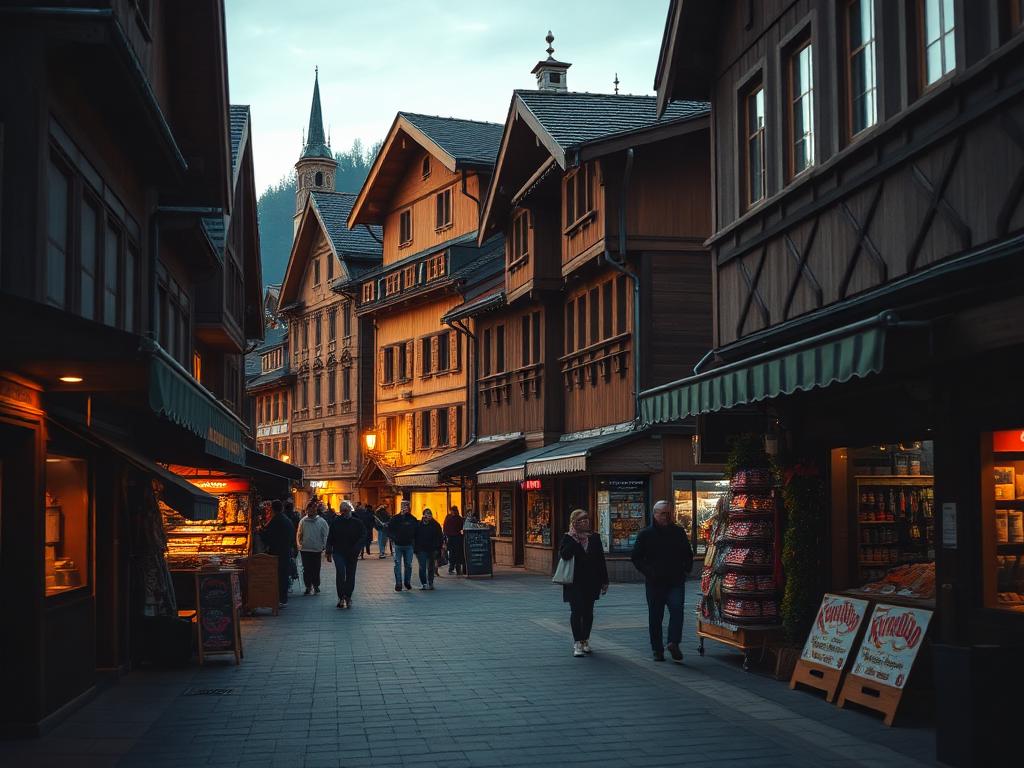
As you climb the final kilometres into Zakopane itself, the architecture keeps shifting to match the terrain. Flat roofed modern buildings give way increasingly to steep gables, carved wooden balconies and the distinctive Zakopane style pioneered by the architect Stanisław Witkiewicz in the late nineteenth century, a style that deliberately drew on highlander farm building traditions and turned them into something resembling a national architectural identity. By the time Krupówki street and its crowds come into view, the transformation from Kraków's baroque courtyards to mountain resort chalet is complete.
Choosing your own branch
It is worth being honest with yourself and your passengers before that fork appears: neither branch is the wrong choice. The eastern road through Rabka-Zdrój and Nowy Targ gives you spa town calm, a historic market town, a strip of classic Podhale villages and a genuinely charming food stop at Bacówka u Edka. The western road through Czarny Dunajec gives you quieter tarmac, one of the finest traditional streetscapes in the country at Chochołów, and an earlier, sharper introduction to the mountains themselves near Witów.
Families travelling with children often lean eastern for the animals and grilled cheese at the roadside hut. Photographers and architecture lovers often lean western for Chochołów's long wooden row and the dramatic approach through the valley mouths. Neither preference is fixed, and plenty of regular visitors alternate branches from one trip to the next simply to see the region from a different angle.
What matters far more than the branch itself is treating the last hour of the drive as part of the holiday rather than an obstacle to it. Slow down where the road allows, glance at the barns and church towers, let the mountains arrive in their own time. By the time you are parking in Zakopane, the shift from Kraków's plain to the roof of Poland will already have done a good deal of the work that the mountains themselves are about to finish.